The Speed Dating Conversation About Investing in AI Startups
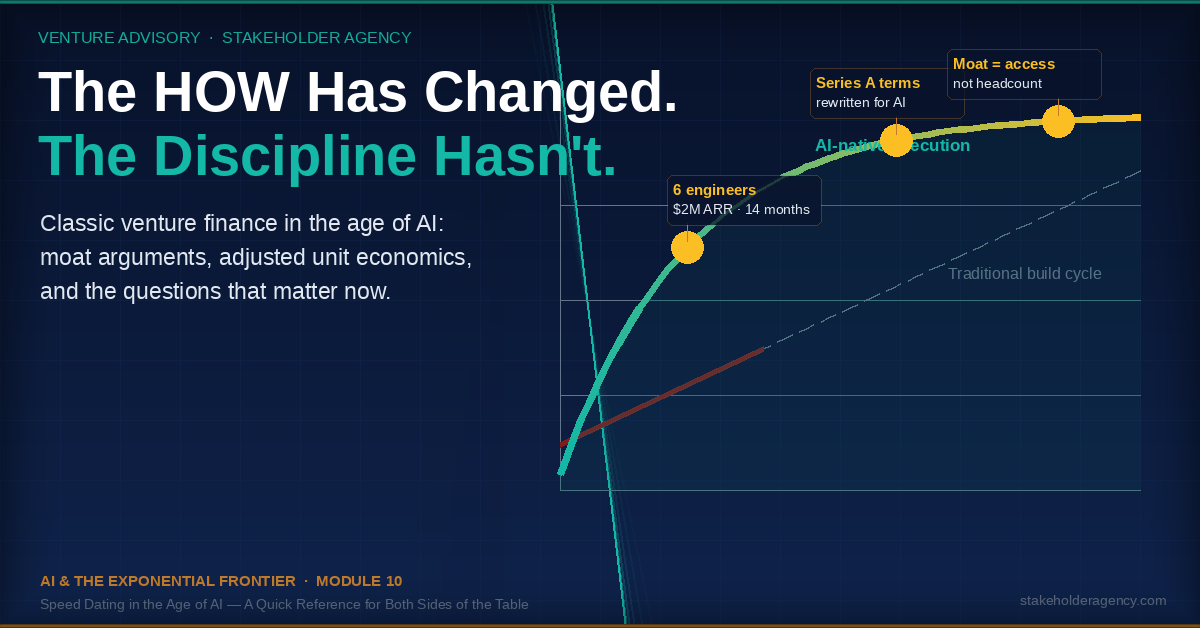
What every investor–investee conversation needs to cover right now
The circuit is live again.
Another season of venture events around the world. Demo days, investor summits, innovation festivals — the calendars of founders and investors are filling up with the familiar rhythm of five-minute pitches, crowded reception rooms, and the quiet intensity of two people trying to assess whether they belong in each other’s future.
But something has shifted in these rooms. The conversations feel different. The questions are harder. The founders walking in are leaner, faster, and often — disconcertingly — more capable than their team size suggests they should be. And the investors sitting across the table are recalibrating frameworks they have relied on for a decade.
We have entered the age of AI. Not as a theme, not as a sector, but as an operating condition. It is the context inside which every venture conversation now takes place.
Here is the quick reference guide I use with clients on both sides of the table — so that the next time you have a few minutes to make or receive a first impression, you are asking and answering the right questions -and I will love to hear your questions and comments very much!
Why This Moment Matters
The cost of building a venture has fallen dramatically. AI is compressing development timelines from months to weeks, design cycles from weeks to hours. A founding team of three can now ship what five years ago required fifteen. A solo technical founder with the right tools can reach $1M ARR without making a single engineering hire.
For investors, this creates a genuine interpretive challenge. The signals they have trained themselves to trust — team size as a proxy for execution capacity, burn rate as a proxy for seriousness, months to MVP as a proxy for technical difficulty — are no longer reliable. A small team and a low burn might mean extraordinary leverage rather than limited ambition.
For founders, this creates an opportunity and a responsibility. AI leverage is a genuine competitive advantage, but it only counts if you can articulate it clearly and defensibly. The investor sitting across from you has heard a dozen founders that week claim the same advantage. The ones who stand out are the ones who can explain exactly where their leverage comes from — and why someone else cannot replicate it tomorrow.
The conversations that happen at these events are not just about specific companies. They are about two parties trying to establish whether they share a mental model of the world they are operating in. In 2026, that mental model has to include AI. What follows is the framework I use to make sure it does.
The AI Leverage Matrix: Placing Any Venture on the Map
Before any conversation about valuation, team, or market size, both sides benefit from a shared map. I use a simple 2×2 framework to place any venture in the AI landscape:
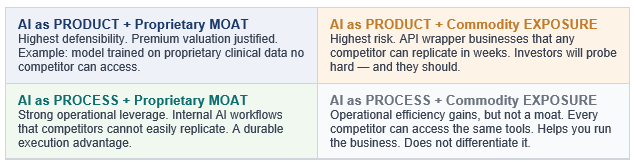
Placing a venture on this matrix before discussing numbers tells you the investor’s most likely objection — and the founder’s best response. It is the fastest way to get a conversation past superficial AI claims and into the substance of what is actually defensible.
The Quick Reference: Questions for Both Sides
What follows is the practical reference I share with both investor clients and founder clients before they walk into these rooms. It is not exhaustive. It is the minimum viable framework for a conversation that goes somewhere real.
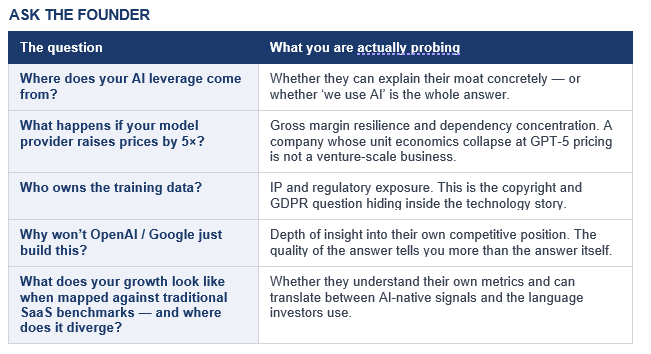
If you are the investor:
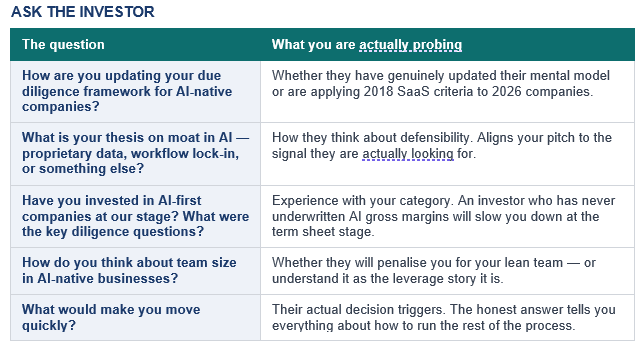
If you are the founder:
The Unit Economics Conversation Has Changed
The numbers conversation at these events used to follow a familiar script: ARR, growth rate, gross margin, burn multiple, months of runway. That script has not been retired — but it has been complicated.
A six-person team at €2M ARR is no longer a sign that something is wrong. It might be the headline. The question investors need to answer — and founders need to pre-empt — is whether the lean structure reflects genuine AI leverage or simply a company that has not yet invested in the capacity it needs to grow.
For founders: be specific about what AI does in your business and what it does not. Investors who have been in these rooms for the past eighteen months have become adept at separating the companies where AI is compounding the business from the ones where it is dressing it up. The former get term sheets. The latter get polite passes.
For investors: update your burn multiple benchmarks. The old rule of thumb — that a burn multiple above 1.5 at Series A is a yellow flag — needs to be read differently for a company whose AI infrastructure is genuinely building a proprietary data asset. Sometimes the burn is the moat.
The Moat Argument:
Getting It Right in Six Minutes
The most important conversation at any venture event right now is the moat conversation. Every founder building with AI is facing the same question, usually within the first three minutes: “Why can’t OpenAI / Google / a well-funded competitor just build this?”
Most founders answer this question defensively — listing features, citing integrations, emphasising their head start. The answer that actually lands is different. It focuses on three things that a generalist AI provider structurally cannot replicate: proprietary data accumulated through deep customer relationships, workflow integration that creates genuine switching costs, and domain expertise that is not available as a public training dataset.
The best moat arguments I have heard at these events are not about technology. They are about access. Access to data that nobody else has. Access to a workflow that nobody else will spend the time to understand. Access to a customer relationship where trust and switching cost compound together over time.
If you are a founder, practice this argument until you can deliver it in ninety seconds without notes. If you are an investor, listen for the difference between a feature list and a structural access argument. It is the single most important signal in an AI-native pitch.
The Mindset Shift Nobody Is Talking About
Beyond the frameworks and the reference questions, there is a deeper shift happening in these rooms that is harder to codify but impossible to miss once you notice it.
The founders who are raising right now — the ones who close rounds in these fast, compressed conversations — share a particular orientation. They are not simply using AI to build faster. They are thinking about their business in terms of what becomes possible at AI speed, not what is incremental on what came before. They are asking themselves: what would this look like if building were ten times cheaper and ten times faster? And then they are building that company.
The investors who are writing the best cheques right now share a complementary orientation. They have updated their mental models without abandoning their discipline. They are rigorous about unit economics, but they have recalibrated the benchmarks. They are serious about team quality, but they have stopped treating team size as a proxy for capability. They are focused on moat, but they have expanded their definition of what a moat can be.
For the Next Conversation You Have
Venture events are fundamentally about trust formation under time pressure. The six minutes you have to make or receive a first impression are not enough to do a deal. They are enough to establish that you are both operating from an updated mental model — one that takes AI seriously not as a buzzword but as a structural condition that has changed the economics of building ventures.
Use the matrix to locate the conversation. Use the questions above to move it forward. And if you find yourself in a conversation where both sides understand that the discipline has not changed but the execution has — take a few extra minutes. That is a conversation worth having properly.
This article is part of an ongoing series on Venture Finance Mastery — a dual-perspective training programme for advisors, founders, and investors navigating the full cycle of venture finance. Module 10 covers AI and exponential technology as a structural shift in how ventures are built, valued, and funded.
If this resonated, I’d welcome a conversation. The best discussions I have happen when both sides of the table are prepared for them. Visit StakeholderAgency.com for more articles, programs and Venture Financing Training.